




Key trends
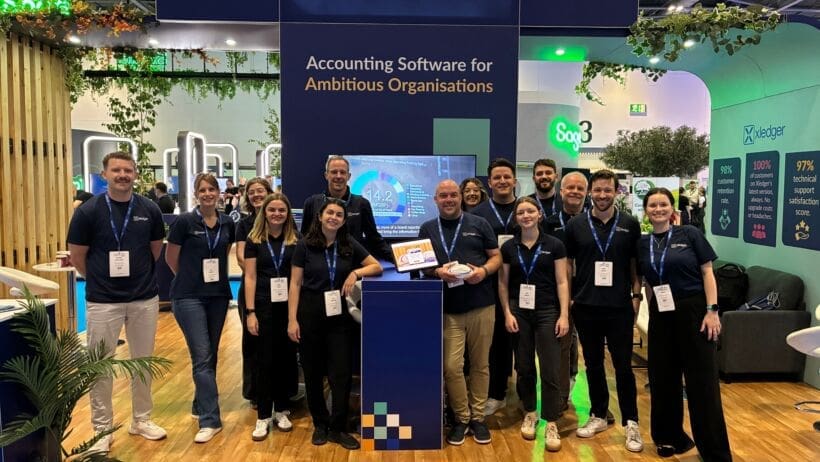
In case you couldn’t attend Accountex this year, here’re the main topics of discussion we came across while chatting to other finance and accounting professionals.
- Mid-market organisations using small-to-medium enterprise (SME) accounting software lack the scalability that supports their growth.
- Artificial intelligence gimmicks shouldn’t overshadow practical use cases that enhance efficiency and insights – look to providers with clear AI roadmaps.
- Security, compliance, and governance are fundamental to building robust financial controls.
- Digital transformation is more important than ever to ensure companies keep pace with the rate of technological change.
- Meticulous resource planning is non-negotiable for organisations undertaking large finance implementations and digital transformation projects.
Throughout the two-day event, many organisations presented insightful speaking sessions ranging from the emotional connections finance teams have to their systems to new HMRC-mandated e-invoicing updates. Our very own Neil Wildy (PM Manager) and Tim Wright (Operations Director) took to the stage with our customers, Comic Relief and Trussell, to discuss how organisations can continue to optimise their finance solutions after go-live. 
Many conversations centred around trust. Some finance professionals felt distrust of their data while using outdated systems. Others felt distrust for new AI functionality if the practicality of the AI wasn’t clear. And some professionals were actively creating data lakes to improve trust in their organisation’s financial and non-financial information.
Our industry survey
Consistently, prospects raised the concern that their current finance system underdelivers strong automation, insights, and integrations. To understand these issues in more depth, we asked 60 finance professionals about the types of accounting systems they used.
According to our qualitative survey spanning industry and in-practice finance professionals, 33% of respondents rely heavily on manual processing to complete financial tasks. Furthermore, 25% of respondents lack real-time insights that help agile decision-making. With over half of respondents using small business accounting software, it’s clear that evolving organisations require greater flexibility and stronger automation from their finance systems.
Interestingly, only 30% of respondents stated they were very confident in the accuracy of their financial data, confirming a lack of access to live financial insights and distrust in small or outdated finance systems. However, only a small minority (13%) expressed low confidence in their data, indicating that organisations can ultimately make business decisions but may rely on excessive manual reconciliation and consolidation to make data easily digestible.
When answering which trends would grow over the next 3-5 years, almost every participant included AI in their response, with around two-thirds explicitly referencing automated AI as a key area of growth.
What to expect in the year ahead
Looking beyond Accountex 2026, we expect the finance and accounting industry to focus less on experimentation and more on practical technologies and use cases. Although AI will remain a major talking point, conversations will centre more around what’s happening currently, as AI isn’t the future: it’s the here and now.
For software providers, digital transformation advisors, accounting firms, and technology partners, this means that governance and strategy must be a priority when unlocking new value for customers.
Finance leaders and decision-makers considering digital transformation must recognise that automation and AI are only effective if the underlying data is accurate. Trust in data is key to successful business operations.
Next steps
For organisations still relying on fragmented or legacy solutions, the message is simple: digital transformation is no longer optional. Those who invest in scalable finance systems will be best placed to build trust in their data, support business growth, and keep pace with continuous regulatory change.
Learn more about our finance software or book a product tour with our dedicated team to learn how Xledger prioritises compliance, security, and insights for organisations across a variety of industries.